
Generative Engine Optimization (GEO) is how you get your content cited and surfaced by AI-powered search — Google's AI Overviews, ChatGPT, Perplexity, and Gemini — instead of only ranking in the traditional blue links. More and more people now get their answers straight from AI, and GEO is how your business stays visible in the places buyers actually look.
Here's what we'll cover: what GEO really is, how it's different from traditional SEO and Answer Engine Optimization (AEO), why it matters right now, and the practical steps to get your site showing up in generative AI search.
What Is Generative Engine Optimization (GEO)?
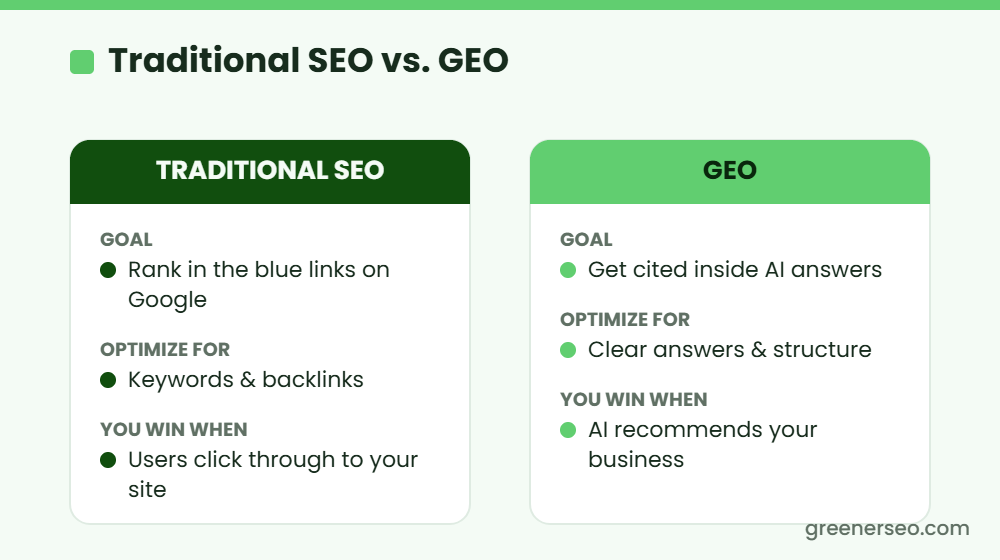
Generative Engine Optimization is the work of structuring and strengthening your content so AI engines understand it, trust it, and quote it in their answers. Traditional SEO tries to rank a page in a list of results; GEO tries to make your brand the source an AI actually cites when it writes a response.
In plain terms, that means writing clear, factual, well-organized content, making it obvious who you are and what you do, and giving AI the signals it needs — schema, citations, and consistent information — to reference you with confidence.
GEO vs. SEO vs. AEO: What's the Difference?
All three overlap, but each one optimizes for a different destination:
- SEO (Search Engine Optimization) — earns rankings in the traditional organic results (the blue links) on Google and Bing.
- AEO (Answer Engine Optimization) — optimizes for direct answers: featured snippets, "People Also Ask," voice search, and answer boxes.
- GEO (Generative Engine Optimization) — optimizes to be cited inside AI-generated answers from tools like Google AI Overviews, ChatGPT, Perplexity, and Gemini.
They're built on the same foundation — quality content, a healthy site, and real authority — but GEO leans harder on being machine-readable, worth citing, and crystal-clear about your brand. The upside: good SEO and AEO make GEO much easier, because AI engines rely on many of the same signals that rank content the traditional way.
Why GEO Matters Now
Search habits are changing fast. Google now shows AI Overviews on a big share of queries, and millions of people ask ChatGPT, Perplexity, and Gemini the questions they used to type into a search box. When AI answers directly, the click to your site may never happen — unless you're the one being cited. Establishing your authority early is what keeps AI engines coming back to your brand, and that head start is hard for competitors to claw back later.
How Generative Engine Optimization Works
AI engines build answers by pulling from sources they consider relevant and trustworthy. GEO is about earning that trust. It comes down to a handful of levers:
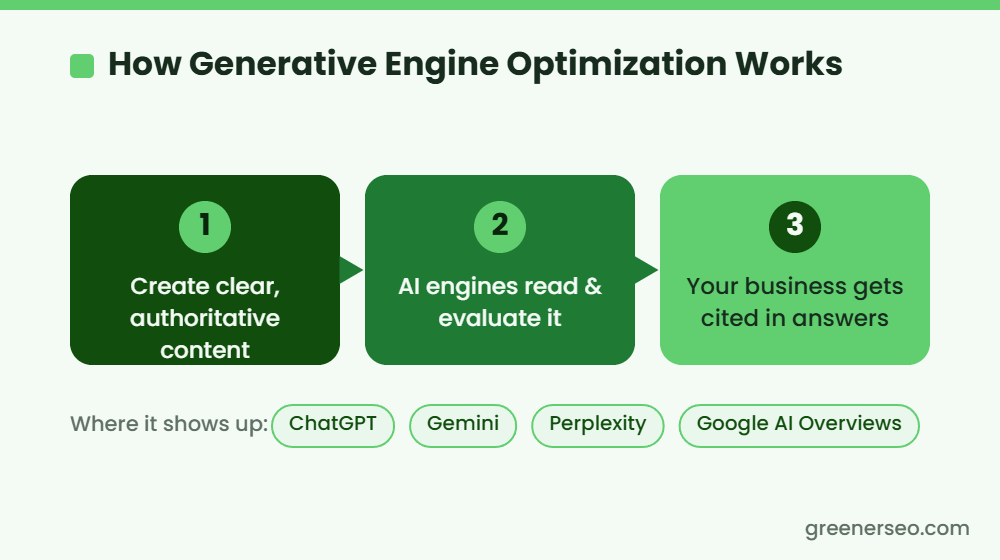
- Clear, answer-first content — open with a direct answer to the question, then back it up. AI models grab concise, self-contained statements, so give them one.
- Strong entity and brand signals — keep your name, location, and services consistent across your site and the web, reinforced with Organization and Service schema.
- Structured data — schema markup (FAQPage, Article, Service, Organization) that spells out exactly what your content means.
- Topical authority — cover your subject thoroughly and link it together so engines treat you as an expert, not a one-off.
- Credibility and E-E-A-T — real expertise, author bios, accurate facts, and references that make your content worth quoting.
- Technical accessibility — fast, crawlable pages that AI systems can actually read and index.
How to Optimize for GEO: A Step-by-Step Approach
- Answer real questions directly. Find the questions your customers ask AI, and answer each one in the first sentence of a section.
- Structure for extraction. Use descriptive H2/H3 headings, short paragraphs, bulleted lists, and FAQ sections so answers are easy to lift out.
- Add the right schema. Mark up your FAQs, articles, services, and organization so AI understands the meaning behind the words.
- Build entity authority. Keep your name, address, and details consistent everywhere, and strengthen your author and brand profiles.
- Earn mentions and links. Citations from reputable sites make AI engines more likely to trust and quote you.
- Keep content current and accurate. AI favors fresh, factual sources, so revisit your key pages regularly.
GEO Tools
A growing set of tools track how often AI engines mention and cite your brand — Ahrefs Brand Radar, Profound, and Otterly among them. They're handy for measuring your AI visibility, but the real work is still great content and genuine authority.
Frequently Asked Questions
Is GEO the same as SEO?
No. SEO optimizes for rankings in traditional search results, while GEO optimizes to be cited in AI-generated answers. They share the same foundation of quality content and authority, but GEO adds emphasis on being machine-readable and citation-worthy for tools like ChatGPT and Google AI Overviews.
What is the difference between GEO and AEO?
AEO (Answer Engine Optimization) targets direct answers like featured snippets and voice results, while GEO (Generative Engine Optimization) targets citations inside AI-generated responses. AEO is a strong stepping stone to GEO, and both rely on clear, structured, answer-first content.
How do I optimize my website for AI search?
Lead with direct answers, structure content with clear headings and FAQs, add schema markup, build consistent entity and author signals, and earn credible mentions. In short: make your content easy for AI to read, trust, and quote.
Does GEO replace SEO?
No — GEO complements SEO. Strong traditional SEO makes GEO far easier because AI engines draw on many of the same ranking signals, so the smartest approach optimizes for both at once.
Get Found in AI Search
Generative Engine Optimization is the next frontier of getting found online, and the businesses that move early will hold the advantage. At Greener SEO, we help you show up in both traditional and AI-driven search — take a look at our Answer Engine Optimization services and our full Houston SEO services, or contact us for a free strategy session.


